Wednesday, August 22, 2018

In the Room Where It Happens

Have you ever experienced a moment when you know something important has shifted and moving forward things will never be the same? It’s like being in “the room where it happens”, as the song from Hamilton goes. Last night I was in the room where it happens at Ascension. 

The meeting of our Congregation Council (that’s what we call our Board in the ELCA) was unlike any I have attended since I arrived at Ascension. We didn’t meet during July, so we had a lot to cover. As an aside, I found out why we don’t meet in July from our President, Kim. She said it started something like 20 years ago when the pastor at the time was always away during July. Seriously? That’s like the old story of the woman who was constantly cutting off the end of the ham before she baked it. When her husband asked why she always cut off the end of the ham, she didn’t know; that’s the way she had learned to cook it from her mother. So she asked her mother, “Why do we always cut off the end of the ham before we put it in the oven?” Her mother informed her that she had to cut off a couple inches so it would fit into the pan she had. And so it goes. But you never know until you ask. (It may be time to revisit the practice of no July Council meeting at Ascension.)

As a result of missing a month, we had a lot of ground to cover at our Council meeting. But that’s not what made it so unusual. It was unusual because of the way people engaged in the process. 

We’ve been beginning our meetings with a book study that we’re doing all year. It’s about adaptive leadership. The discussion last night was about how to change the DNA of an organization. Unlike some months when I lead this part of the meeting, everyone seemed to have something to say. They are really wrestling with what adaptive leadership looks for Ascension. 

Next came approval of the June minutes. Also a part of the agenda that normally slips by with minimal discussion. Not so this time. We spent considerable time reviewing one of the goals the Council set for themselves over the next year. After a variety of perspectives were expressed, we eventually decided to scratch the goal. I was surprised by the passion people had around this. They didn’t hold back. Emotions ran high. And here’s the part I loved. They listened to one another. They disagreed and were experiencing a lot of cognitive dissonance, but they were open and they hung in there. And when all was said and done, we landed in a different place. 

We were not wrestling with a small thing like the color of the carpet or what to serve at a potluck. This was the big stuff. The stuff that Councils are supposed to be wrestling with. DNA type stuff. Do we focus our attention on reducing our mortgage? It weighs us down financially as we are not meeting our monthly payments from offerings and continue to dip into a fund that won’t last forever.  In addition, we live with the knowledge that in three years our interest rate will be changing, and we assume it will go up.  So the desire to reduce our mortgage is not unfounded. But then, there are some on the Council who are frustrated that we have emphasized reducing the mortgage in a way that is perceived as putting mortgage above ministry. 

One member put it well when she said that we all have mortgages at home. Should we just use all our money to pay off our mortgages without giving to the church? To her, that’s the message we are sending by focusing so much on paying off our mortgage. She made a similar point when we were discussing this at a previous meeting, but at that time she didn’t get much traction. This time she was not alone. And so, we were really hashing it out together. 

It’s a struggle that any congregation with a lot of property deals with. It’s so easy to invest all our time and energy on property needs at the expense of ministry. On the other hand, a congregation ignores property needs at its own peril. And things like heat, and electricity, and a roof are valuable resources that allow ministry to take place. (These are the kind of things that our building renovation covered. Nothing fancy, but necessary. And the mortgage lingers.) But does it have to be an either/or dilemma? Can vibrant ministry take place while we’re maintaining our building? Can opportunities for ministry increase while the mortgage decreases? 

I must add that Ascension is a generous congregation. We don’t sink every spare dime we have into reducing our mortgage. We are committed to tithing to our synod and giving to other ministries beyond the walls of the church building. This discussion was prompted because the congregation had just received a huge undesignated bequest. We put it into reducing the mortgage and doing some needed building improvements, which was pretty much assumed when we received it. But apparently, Council members had spent some time rethinking our decision, and they were feeling compelled to challenge it last night. As a result, we decided to take 10% off the top of all undesignated bequests and put it into a fund that the Council will manage for the purpose of supporting ministries outside our budget. It was a positive way to resolve the conundrum, and I have the sense that all felt good about it. 

The end result isn’t what I’m thinking about today. I’m thinking about the energy and passion in the room and how people freely expressed it. It was tense. It took a while. But it was a discussion of substance. It was about vision and really big stuff like faith and fear and what God would have us do. And we did it. 

This is why I have such confidence that Ascension has a future. I’m sensing a shift among the leadership and among members of the congregation. It’s a bit scary at times. But it’s such an honor to be in the room where it happens. Thank you, God.


Monday, August 6, 2018

Unlocking the Mystery of God's Will for Your Life

When I was a kid and my mom’s birthday was coming up, I would go to her and ask, “What do you want for your birthday, Mom?” And her answer was always the same. “Nancy, if you want to give me something, clean your room.”

Well, that was the last thing I wanted to give my mother for her birthday, and at the time I thought she was just being uncooperative. So I would go out and buy her something that I thought she might like. But you know, now that I’ve been a mother with kids who kept their rooms a lot like I did when I was their age, I understand what my mom was saying. And I realize that she meant it. The best present I could have given her would have been cleaning my room.

It seems like we all struggle with discerning God's will for our lives. We long to have a clear answer to the question, "What do you want from me, God?" But I've come to the conclusion that we aren't any more interested in hearing what God really wants from us than I was interested in hearing what mom really wanted from me.

After all, it’s not such a great mystery what God’s will is for our lives and discerning it is not like the search for the Holy Grail. We don’t have to go any further than the baptismal liturgy where we present a lighted candle to the newly baptized and say: “Let your light so shine before others that they may see your good works and glorify your Father in heaven.”

God’s will for our lives is spelled out for us repeatedly in the scriptures. One of my favorite passages is from Micah 6:8: “What does the Lord require of you but to do justice, and to love kindness and to walk humbly with our God?” That’s pretty clear to me. Jesus himself gives us lots of instructions, including: “If any want to become my followers, let them deny themselves and take up their cross daily and follow me” (Luke 9:23). He summed it all up by telling us that the most important thing we can do with our lives is love God by loving one another. “By this everyone will know that you are my disciples, if you have love for one another”(John 13:35). 

We have tons of scriptures that clearly tell us what God’s will is for his people. And yet, we act like it’s some great unsolved mystery. Why? Is it that we don't believe God really means it? Or could it be because we simply flat out don’t want to do it?

Monday, July 16, 2018

Can you handle God's Truth?

From sermon at Ascension, Towson - July 15. Mark 6:14-29; Amos 7:7-15


When Herod first hears about Jesus, he has a flashback, and he wonders if John the Baptist has risen from the dead. Because there are so many similarities between John and Jesus. Both are radicals. Both are prophets, proclaiming God’s message outside the religious and political establishment. Both are poor men, relatively powerless in the world. And both John and Jesus scare the bejeebers out of Herod.

Herod recalls the night John met his demise. Here’s what led up to it. Philip and Herod were brothers. They were also both uncles to Herodias. Philip married Herodias and they had a child together, a daughter. Herod was married at the time, too. Well, Herod and Herodias got the hots for one another, and they decided to divorce their spouses, one of which is Herod’s own brother, so they could marry each other. (This is like something on an episode of The Jerry Springer Show, right?) 

So that’s what John’s ranting about. And Herod doesn’t know how to shut him down. But his wife does. When Herod offers to give his stepdaughter anything she wishes after performing what must have been one amazing dance, she consults her mother for advice. Backed into a corner, Herod grants her wish, the head of John the Baptist on a platter.

You can see how that might be the sort of thing that would haunt Herod. (It haunts me, and I’ve only read the story in the Bible.) So, hearing about Jesus leads to this traumatic flashback for Herod. And this story of John speaking God’s truth and being killed for it, serves for us, the readers of Mark’s gospel, not as a flashback, but as a flashforward. A foreshadowing of what’s about to unfold in the story of Jesus. 

There’s something for us to learn, as well, as people who follow in the way of Jesus… who followed in the way of John… who followed in the way of the Old Testament prophets… We come from a long tradition of people who were called to speak God’s truth to a world that finds that truth threatening. 

Today’s first reading is from the prophet Amos. It talks about a plumb line that God puts in the middle of Israel. A plumb line is something people use in construction to make sure walls are built in a straight line. 

Amos says that God has a plumb line, too. It’s the line of God’s righteousness, and God’s people are judged according to how their lives line up with God’s righteousness.

Jesus introduced a plumb line of his own. He called it the Kingdom of God. The challenge for us as Christians is to take the vision of the Kingdom of God as it’s revealed to us by Jesus, lay it alongside the ways of the world and ask, how do they line up? 

Now, the only way to get a handle on what the Kingdom of God looks like is by studying the Scriptures. And when we study the Scriptures, we learn just how radically different the Kingdom of God is from the ways of the world. 

We live in a world that rewards people based on their merit and insists people get what they deserve, but in the Kingdom of God, people receive grace, which has absolutely nothing to do with what they deserve. Our world insists strength is shown by exerting power over others; in the Kingdom of God, strength is shown in service and giving yourself for others. In the world around us, when someone hurts us, we strike out and hurt them back; in the Kingdom of God, we respond to hatred with compassion—we turn the other cheek and pray for our enemies. 

And the really big thing we learn when we study the Scriptures, in particular the way of Jesus, is that God has a bias toward the bottom. God sides with the poor, the outsiders, and the oppressed. As people who are affluent, well-positioned in life, and who benefit from the status quo, that’s not something we want to hear. 

When we lay the ways of the world around us alongside the ways of the Kingdom of God, we can’t ignore the disparity or look the other way. We see God’s truth. How do we respond to it?  

Now this is hard for most of us. But I don’t know if you realize what a struggle it is for those of us who preach. It’s the sort of thing that has me tossing and turning on Saturday nights.  

I want you to like me. It would feel so good to stand before you week after week and tell you funny stories, and talk about my grandkids and my cat, and assure you that God doesn’t want any of us to change. 

I really don’t want to ruffle your feathers or become a source of anger for you. And that presents me with a dilemma. Because I can’t preach whatever I want to. I’m called to proclaim the truth of the Scriptures to you. And I work as hard as I can to do that—praying that the Holy Spirit will guide me. 

I know that many people have been conditioned to believe that preachers aren’t supposed to talk about politics from the pulpit. I’m not sure where that idea comes from, but it couldn’t have come from anyone who actually reads the Bible. When you read the message of the Scriptures—and I’m not talking about snacking here and there, but really feasting on the whole enchilada—a major theme of the Scriptures is speaking truth to power. 

That’s how it all started for God’s people when a motley group of slaves sought freedom from their oppressors. It was the message of the prophets in times of corruption and years of exile. During Jesus’ time, Israel was living in subjugation to the Roman Empire. That political reality colored everything Jesus said and everything he did. 

Partisan politics, that is endorsing a certain political party or candidate, has no place in the church. But addressing the political world is another matter. When we consider the witness of Jesus and his followers, seeking faithfulness to that story and relevance to our own, we have to ask, how do we faithfully respond to our own Empire?

This isn’t just a struggle for preachers. It’s a struggle for all of us as God’s people. And it’s a struggle for the Church as an expression of Christ’s presence in the world.

We don’t have the option of remaining silent so that people will like us. We may be considered offensive at times. We may be considered impolite. Like Amos. Or John the Baptist. Or Jesus. We may not get invited to many parties and when we are, we may end up the main course. 

That’s what happens when you lay the Kingdom of God alongside the Kingdoms of this world. You notice the difference and it’s not something you can live with.  


Saturday, July 14, 2018

The importance of being right

When I was in college, my roommate was dating a grad student who was way smart. I always thought I was well endowed in the brains department, but he had it all over me. His mind sucked up facts like a vacuum cleaner. Every night during supper, when Jeopardy came on TV, he enjoyed sharing his vast knowledge with us. I listened and silently gnashed my teeth, never daring to challenge him because he was just about always right. 

When I was handed an unexpected opportunity to stick it to him, I couldn’t resist. I happened to watch Jeopardy while I was home for Christmas break. Then, when I returned to school, lo and behold, an exact same episode that I’d already seen the week before was being aired on TV. It was like a dream come true! I pretended that I had never seen it before, as I called out all the right questions, including a few that he missed. Although I acted as nonchalant as possible about it, inside I was whoopin’ and hollerin’ and jumpin' up and down. Yes! 

It felt so good that I never told him the truth. To this day he thinks that I mopped the Jeopardy board with his face that night. Actually, he’s probably forgotten all about it. But not me! I will never forget it. At the time, I thought of it as an impressive victory. Now I look back and I realize it was NOT one of my finer moments. How could I have been so deceptive?

I wonder how many people in a similar situation would be able to resist such an opportunity? I mean, isn’t being right a rush for all of us? There’s something about it that satisfies us on a basic level. Why is that?

I suspect it’s a competitive thing. If you’re right, that means you’re superior to the person who is wrong. And who doesn’t love feeling superior? If we can point to someone else and say, “I’m better than she is!” it’s proof positive that we’re worthwhile.

Maybe this is one reason why some of us are so offended by the notion that God unconditionally loves ALL people. In the church we call it grace. It’s love freely given, with no strings attached. It’s loving someone just because. That’s exactly the way God loves us -- just because.

For those of us who have a need to feel we’re special, and I suspect that’s pretty much all of us, the undiscriminating grace of God can leave us feeling slighted. Of course, to God, we’re special, and that’s fine with us. But the problem is that, to God, EVERYONE is special. How can anyone be special if everyone is special? And how can we feel superior to other people if God loves everyone the same, whether they’re perfectly right or terribly wrong? Now, I realize that’s a very human perspective and I think it’s safe to say that a God of grace doesn’t see things that way.

Certainly, our need to be right takes on epic proportions when we align our rightness with God’s. It’s not so much a problem when we try to think like God; it’s when we convince ourselves that God thinks like us. And when we’re so hell-fire sure that God thinks like we do, well, we have to be right, by God! We’ll fight to the death to prove that we’re right because so much is at stake. It’s a scary place to be. And, ironically, it is exactly what a life in relationship with God is NOT.

To be in an authentic relationship with God, we have to be able to utter three words that so many of us find it pert near impossible to say: I was wrong. Until we can acknowledge that we’re not always right and quite often we might actually be wrong, we’ll have so much invested in proving we’re right that we can never let God be God.

Do you have an aversion to the words, I was wrong? It’s a true spiritual handicap that isolates us from God, as well as other people. And it keeps us from growing into the people God created us to be. That’s why, as painful as it is, every once in a while, it helps us to be reminded that we can be wrong. You might say that an occasional serving of crow is good for our spiritual health.

Sunday, July 1, 2018

Get Out of My Way!

Preached at Ascension Lutheran Church, Towson MD - July 1, 2018. (Mark 5:21-43)

I hope you’re up for a sandwich this morning. As in a Mark sandwich. His gospel is a veritable sandwich shop. He will begin with story A and then, before he finishes it, he inserts story B, and then he goes back to story A.
Today’s Mark sandwich could be called the Women in Crisis Sandwich. We don’t know their names, but they’ve both become outsiders. And Jesus is not only dealing with healing them of their illnesses, but he’s also erasing the lines that separate them from others.

The religious laws of the time said that neither a menstruating woman nor a dead person should be touched. If you touched them, then you’d become impure and you’d have to go through a lengthy, involved ritual to be made pure again.
Now, as the leader of the synagogue, Jairus knows all about those purity laws because he’s the one who must enforce them. He is a person of prestige in his community. Well-respected. The one other people listened to. And so, the public display he makes of himself here is really quite shocking. He falls at Jesus’ feet and begs Jesus to help his daughter. And, just like that, Jesus is on his way to Jairus’ house, with a large crowd of people tagging along.

Then, right there on the road, Jesus’ mission is interrupted. This is no doubt upsetting to Jairus, who was in a hurry to get Jesus to his daughter before it was too late to save her.
There’s a woman in the crowd. A woman who’s been bleeding for 12 years, which, we learn later, is the age of Jairus’ daughter. The entire time this little girl has been alive, the woman in the crowd has been on her period. Perhaps only a woman could appreciate what that might have been like, but a good word to describe the woman would be tired. The worst part of this for the woman isn’t physical, though. It’s relational. Her sickness has completely removed her from contact with other people.

Not only did the purity laws say that you can’t touch a woman who is menstruating, but you also couldn’t even touch anything that SHE touched, or you’d be unclean. So, for twelve years, the woman has lived in social isolation. Like Jairus, she’s desperate. And, like Jairus, in her desperation she’s prepared to take a big risk.
She’s heard about Jesus’ power and thinks that maybe if she can just get close enough to him, she could be healed. She figures out a way to do it so that no one even has to know. It could be a stealth healing. If she blends in with the crowd and just gets close enough to touch the edge of his cloak, she might go undetected.

It doesn’t work. Jesus stops in his tracks and asks, “Who touched my clothes?” This is an absurd question. With the crowd pressing in on him, everybody’s touching his clothes. But one person in the crowd knows she’s been discovered.
Now, remember Jairus? He’s got to be out of his mind about now. He is taking Jesus to save his dying daughter. They don’t have a moment to spare. And here Jesus stops to have a conversation with this random woman. To Jairus it must seem like Jesus has chosen to help some worthless woman instead of his precious little daughter.

Imagine the dilemma that Jesus faces in this story. Either he hurries to the daughter of a rich man, or he stops to heal an outcast woman. He either helps an important person, or he helps a nobody.
Well, what may seem like a dilemma to you or me is no dilemma for Jesus. He doesn’t choose, he does both.

Notice that Jesus doesn’t go out seeking the bleeding woman. He’s on the move, and she’s in his way.
And that’s where ministry opportunities so often find us. We don’t have to go out looking for them. If we open our eyes, they’re right there in our path… Often what we consider an interruption or an obstacle. You may wish they’d just go away, because you’re headed someplace and they are in your way!

It’s a lot like the story of the Good Samaritan where the good religious folk find a man in their path who needs their help. They can’t be bothered, so they walk on by on the other side of the road and pretend not to see the poor man who’s been beaten and left for dead. But the Samaritan sees the man in need and stops to help.
Are there such people we in our path? Perhaps they’re people who find us, or, maybe they’re people God places in our path.

Who is God placing in our path here at Ascension? When we’re longing to follow Jesus and the needs of the world around us seem overwhelming, it’s a good question to ask. Who are the people God is placing in our path?
Can we see them? Are there barriers that keep us from responding to them? Discomfort? Fear?

Lately, we seem to be overly concerned about who’s on our side and who isn’t. Who is worthy of our care and who isn’t. Who we’ll serve in a restaurant and who we can refuse to serve. Who we will bake a cake for and who gets no cake. Who we will respect as a human being and who we will not.
That’s never the way Jesus encounters people. They’re more to him than the laws that keep them in their place. They’re more to him than the labels assigned to them by society. They are God’s beloved. As unlovable as they sometimes are to everyone else, they are always God’s beloved.

As Jesus people, we’re all about living the Jesus Way in the world. This is what it looks like…

What are the lines we draw that make it so difficult for us to see other people as God’s beloved? Pure/impure. Old/young. Rich/poor. Christian/Muslim. Brown/black/white. Republican/Democrat. Gay/Straight. Legal/illegal. Us/them.
Instead of erasing those lines, we’re drawing more of them every day. Those who take a knee for the National Anthem/those who stand for the National Anthem. Those who refer to Donald Trump as the current occupant of the White House/those who refer him as our president. Those who believe everything they hear on MSNBC/those they believe everything they hear on FOX News.
We have doubled-down on our boundaries and shut out those we’ve separated ourselves from. We don’t listen to opinions that differ from our own anymore. We shut them out and only listen to the others who occupy our own tiny boxes.

Friends, this is not the Jesus Way. Our life together, as a community of faith, embodies the Jesus Way. When we enter this place to worship, none of those lines we draw between ourselves and other people matter.
At no time is this more evident than in the meal we share. Do you realize what a radical concept this is in our world today? If Sarah Huckabee Sanders came to our communion table today, of course we would serve her. If a transgender person came to our communion table today, of course we would serve them. Come to the table here and we will serve you, no matter who you are.

Thomas Merton has said it so well: “Our job is to love others without stopping to inquire whether or not they are worthy.”
In our little love laboratory that we call Ascension Lutheran Church, we practice the Jesus Way of love so that we can live the Jesus Way of love in the world. That’s how we usher in the Kingdom of God, by living the Jesus Way in a world that’s about as far from the Kingdom of God as it could be.

We can begin by really seeing the people we encounter, not as obstacles in our way, but as God’s beloved.


Saturday, June 30, 2018

934 Days

If Donald Trump makes it to the end of his term, as of today, 934 days of his presidency remain. If he is re-elected… No, I can’t bring myself to go there.
So far, he has been president 526 days. That means that roughly 526 times I have watched the news at the end of the day, overwhelmed by a combination of disbelief and despair. It's not a good way to go to bed at night. I know I’m not alone. There are many of us who wonder how we will survive 934 more days of this.
Let me say that a part of what makes this difficult for me, personally, is the fact that I serve a congregation where we don’t all agree about our current president. And there are people I honestly love and care for who support him. I continue to love them, even though I strongly disagree with them. This is the Jesus Way. We continue to love one another despite our differences. This means that I will not shut them out of my life. But that doesn’t change the responsibility I have to speak God’s truth. It’s my job, as their pastor, to love them and to speak God’s truth to them. And damn, that’s hard these days.
As I read the Scriptures, I see that God is all about mercy and justice. And by justice, I don’t mean that in a law-and-order kind of way. God’s justice can’t be separated from God’s mercy and compassion. God’s justice is about leveling the playing field. Lifting the lowly and toppling the mighty ones from their thrones. So, God’s justice has a bias—a bias for those on the bottom. Jesus embodied that bias in his life, from the manger to the cross. Following the Jesus Way means standing on the side of the poor and marginalized. 
For the past 40 years, I have been proclaiming the truth of the gospel no matter who our president happened to be. But preaching the gospel is difficult these days because when I do, people think I’m criticizing our president. I don’t even mention his name, but their minds go there. This makes some people cheer while others are angry with me. Can you see why my stomach is in knots these days?
Now, my friends who are Trump supporters tell me that this is how they felt when Obama was president. But I don’t think so. I would compare the way they felt when Obama was president with the way I felt when Reagan was president. It was disturbing, and I was hanging on, waiting for the pendulum to swing, but that can’t compare to the way I’m feeling now.
If you talk to any therapist, they will tell you that the current political climate in America is good for their business. The despair has created a mental health crisis for many people. Some days I feel like I’m hanging on by a thread, but I’m muddling through it.
There are things I’m finding I must do right now, so that I can continue to function in the world where God has planted me. I have to limit my time on social media as well as CNN and MSNBC. (You might be amused to know that my cable package doesn’t include FOX News. It took me over a year to discover this.) I’ve decided that somewhere between burying my head in the sand and wallowing in 24-hour misery, I can find a place that’s healthy for me.
Instead of watching the same train wreck 100 times, I am re-watching West Wing on Netflix. At the end of every day I see what’s going on in the world for about 20 minutes, and then I escape into a fantasy world where Jed Bartlet is our president.
The weird thing is that this is the third time I’ve watched the entire season and I have never reacted to it as I am now. I have a box of Kleenex beside me because, at the end of every episode, the tears flow. I remember being this way with sappy shows like The Waltons and Little House on the Prairie. In the last five minutes they manipulated my emotions. I knew they were doing it, and I cried anyway. But never before has West Wing had this effect on me. I keep putting myself through the tears because it’s a good cry for me. There is an idealism about the show and a patriotism that gives me hope. It’s helping me hold on.
I wonder how many more times I will go through an entire season of West Wing in the next 934 days.

Sunday, May 27, 2018

Pole Dancing for Heretics

The sermon for Holy Trinity Sunday, 2018.
 
We don’t have to re-invent the wheel. It’s what we often say when we’re starting out on a new venture. We look at what other people have done who have faced similar challenges and use what they’ve already figured out. But once upon a time, before there were wheels, there were actually people who invented them. Can you imagine what that must have been like?

2,000 years ago, when the followers of Jesus formed the church, it was a lot like re-inventing the wheel. They did have their Jewish roots, but the notion of a monotheistic God, like the God of Abraham and Sarah, was no longer large enough to explain their experience of the divine. They were pretty much starting from scratch. There was no understanding of the Holy Trinity, and it wasn’t spelled out in the scriptures, anywhere.

The questions that were long ago answered for us were all up for grabs in those early years. Who was Jesus, really? Was he God, was he a human being? How did Jesus relate to God the Creator? Did the Creator create Jesus? And how does the Holy Spirit that came to Jesus’ followers after Jesus wasn’t walking this earth… how does the Holy Spirit fit into all of this?

A variety of understandings were floating around, and things remained that way for about 300 years.

The early Church did finally arrive at the doctrine of the Trinity. God as Father, Son and Holy Spirit was explained in the ancient creeds of the church. Those creeds have continued to define orthodox Christianity all these years later. We have three that we lift up: the Apostles’ Creed, the Athanasian Creed, and the Nicene Creed.

The Apostles’ Creed is also known as the Baptismal Creed. The Athanasian Creed is so long and weird that we rarely use it in public worship.

The Nicene Creed is the one that has the most interesting history. In a nutshell, there was a shady collusion between the Emperor Constantine and the bishops that was all about power. Each wanted to use Christianity for their own purposes, and it culminated at the Council of Nicea in 325. That’s how we got the Nicene Creed.

The original purpose of this creed was to unify the empire by weeding out anyone who didn’t agree. It became the standard that led thousands of heretics to be tortured and burned at the stake.

Over the next 1500 years, although most Christians quit executing those who disagreed with them, Christianity became all about believing in the right way.

Lutherans have been no exception. Most of us lifelong Lutherans, educated in the faith way back in the 20th century, were taught by memorizing the right answers. We weren’t nurtured into the life of faith so much as told what to believe.

This feels like a different flavor of fundamentalism to me. Fundamentalists have the definitive answer to every question. Fundamentalists must have certainty and they can’t deal with ambiguity. Fundamentalists tell us that there is only one right way to believe. Reciting a creed can feel that way, too. It’s like we’re saying, “Here’s what you gotta believe about God.”

As an educator, I have to push back against this. Faith isn’t cast in stone. It develops throughout our lives. A basic level of faith takes everything literally. It’s a right and wrong, law and order way of looking at the world. Something that’s typical of a person in elementary school. Unfortunately, some people get stuck there. But if all goes well, a more nuanced faith develops in our late teenage years, when our brains have grown large enough for us to think abstractly. As our faith continues to grow, we allow for ambiguity and mystery. Later in life, some people pass into a universalizing style of faith that goes beyond all of this. That’s the process of faith development for us. And this is the reason our rigid creeds may not be all that helpful.

But before we throw them out completely, let’s back up a bit and consider how they might serve us in the 21st century.

Creeds are not about faith; they are clusters of beliefs. There’s a big difference between belief and faith, although most people seem to use those words interchangeably.

In Harvey Cox’s book, The Future of Faith, he does an excellent job of making the distinction. He cites a story by the Spanish writer Miguel Unamuno, that goes like this…

A young man returns from the city to his native village in Spain because his mother is dying. In the presence of the local priest she clutches his hand and asks him to pray for her. The son doesn’t answer, but as they leave the room, he tells the priest that, much as he would like to, he cannot pray for his mother because he does not believe in God. “That’s nonsense,” the priest replies. “You don’t have to believe in God to pray.”

The priest in the story recognizes the difference between faith and belief. Faith is more at the core of our being than belief. Beliefs, you can argue about, but not faith. Faith is putting your trust in someone. It’s a way of life. It’s a relationship. It’s of the heart. It’s fluid. It grows. A belief is more like an opinion. It’s of the head. It’s concrete. It’s possible that it may one day be discarded, but it never changes. Again, creeds are not about faith; they are clusters of beliefs.

In his book, Cox separates Christian history into three eras. First, there was the Age of Faith which stretched from Jesus to the time of Constantine in the fourth century. 

Then, from the time of Constantine until now, we’ve been in an Age of Belief. But now, Cox says, we’re entering a new age, the Age of the Spirit. Much like the early church, it’s an age of faith.

We’re returning to a time when doctrinal questions aren’t all that important. There were lots of different beliefs about God floating around in the first centuries of Christianity, and no need to agree on every point. The important thing was not belief, it was faith. No longer identifying correct doctrines but experiencing a relationship with God. In the early church there was never a single Christianity. There were many. It wasn’t until the time of Constantine that we got so hung up on our beliefs and rooting out heretics.

The fact is, despite the church’s attempts to root out heretics, they have always been with us. Thank God! For without them, where would we be? Heresy is healthy for the church. It’s always been the heretics, the ones traveling on the fringes of orthodoxy, who have moved the Christian church to a new place. Martin Luther is the most notable. Heretics have been God’s agents of transformation.

It seems to me that if there is any purpose for our ancient creeds, it’s that they give us a center. We don’t have to agree about everything. But the Trinitarian creeds remind us where the center has been for the Christian church over the past 1600 years or so. That center remains significant for us as we find our way on the journey of faith.

Some of us may be far from the center, but there’s value in knowing where the center is because it’s that center that holds us in community, even as it holds us in God’s presence.

Our Trinitarian understanding of God isn’t the only way God is experienced in the world. For us Christians, it’s our center, but there are other centers for other peoples. And while our centers may be different, often our circles overlap so that those of us who have moved far from the center may find ourselves in more than one circle at the same time.

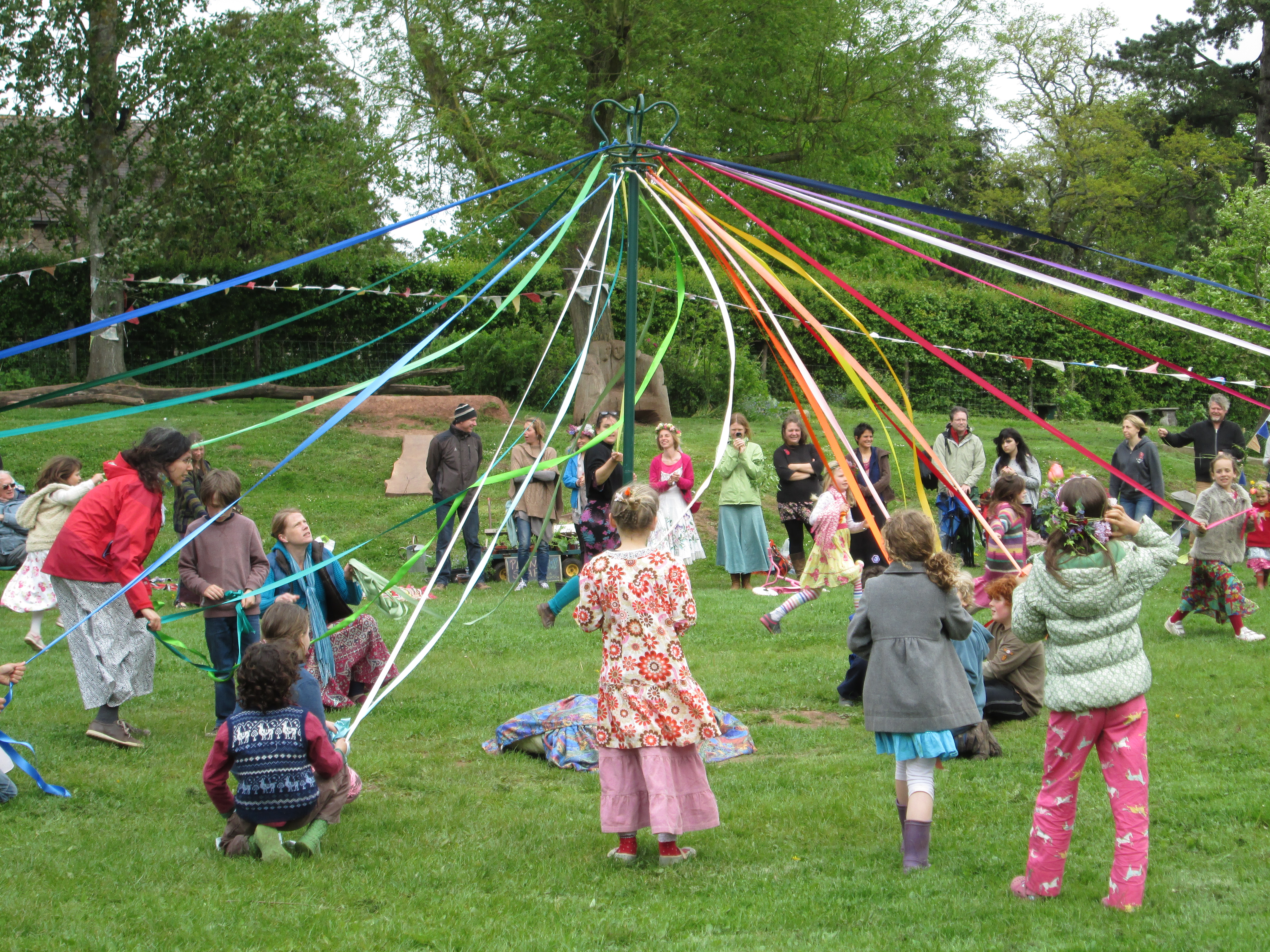
Way back before the Nicene Creed, the metaphor of the dance was used to describe the Triune God. It’s a dynamic faith image. It’s relational, it moves, it grows, it includes. Father, Son, and Spirit are inviting us to dance with them. And maybe, that’s the key to saying the Creed together on a Sunday morning. It invites us into a circle dance. Perhaps it’s something like dancing around a maypole. None of us is required to stand in the center and make a statement of belief that’s a litmus test for God’s people. But we can dance around that center, some close to it, some way out on the fringes, some weaving in and out.

The important thing is that we all share the same center, we’re all in the circle; we’re all in the dance.

 See the source image